Follow the changing fortunes of a fort-town. Filter the chronology and open the evidence behind each event.
The timeline offers dated anchors; the history book connects them into a continuous account. Source-dependent dates remain qualified. Read the history →
24 events · Approximate dates are shown as ranges or periods.
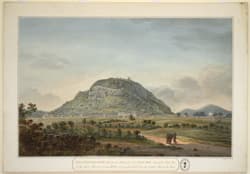
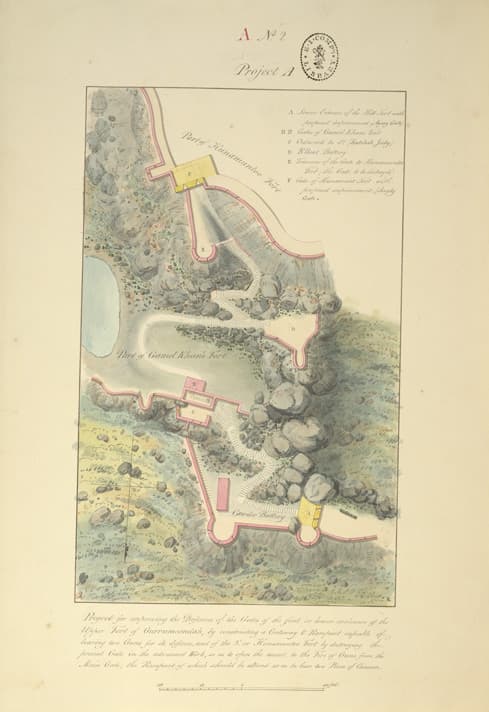
Thomas Fraser · British Library · c. 1802 · WD506.
PRIMARY / ARCHIVAL
How this source is used: Watercolour with a key. The catalogue identifies the lower fort and works covering the ascent. The original digital viewer was unavailable during research.
National Monuments Authority · Ministry of Culture, Government of India · Undated register · Gurramkonda entries in the Andhra Pradesh list.
ARCHAEOLOGICAL
How this source is used: Documents protected remains, including lower fort, wall, moat, gateway, temple, tomb, mandapam and mosque. Older district names reflect the register, not current administrative boundaries.
K. A. Nilakanta Sastri and N. Venkataramanayya · University of Madras; digital transcription at Wisdom Library · 1946 · Volume I, history of Venkata II, printed pp. 316–317.
ACADEMIC
How this source is used: Uses literary and local historical materials. Online OCR is not fully proofread; exact siege year remains unestablished.
Accounts of Venkata II’s reign connect Matla Anantaraju and Kasturi Rangappa with campaigns against Ravella chiefs and forces associated with Golconda.
Powers: Vijayanagara / War
Late 16th century is an approximate placement; no exact siege year is asserted.
K. A. Nilakanta Sastri and N. Venkataramanayya · University of Madras; digital transcription at Wisdom Library · 1946 · Volume I, history of Venkata II, printed pp. 316–317.
ACADEMIC
How this source is used: Uses literary and local historical materials. Online OCR is not fully proofread; exact siege year remains unestablished.
K. A. Nilakanta Sastri and N. Venkataramanayya · University of Madras; digital transcription at Wisdom Library · 1946 · Volume I, history of Venkata II, printed pp. 316–317.
ACADEMIC
How this source is used: Uses literary and local historical materials. Online OCR is not fully proofread; exact siege year remains unestablished.
C. F. Brackenbury · Government Press, Madras · 1915 · Printed pp. 41–45: Nawabs, Maratha campaigns and Mysore.
GAZETTEER
How this source is used: A colonial retrospective gazetteer. Political chronology is paraphrased without adopting its prejudicial descriptions of communities or rulers.
C. F. Brackenbury · Government Press, Madras · 1915 · Printed pp. 41–45: Nawabs, Maratha campaigns and Mysore.
GAZETTEER
How this source is used: A colonial retrospective gazetteer. Political chronology is paraphrased without adopting its prejudicial descriptions of communities or rulers.
Shailendra Bhandare · Oriental Numismatic Society · 2006 · ONS Newsletter 186; Cuddapah and Gurramkonda discussion.
NUMISMATIC
How this source is used: Research based on coin specimens. Some older Gurramkonda attributions are explicitly rejected; undated coins do not establish a precise year.
N. Ramesan · Government of Andhra Pradesh; digitised by IGNCA / ASI Library · 1979 · Historical chapter, printed pp. 42–43.
GAZETTEER
How this source is used: A retrospective district account. Its relationship statement is used carefully; construction dates and genealogy need independent confirmation.
B. Sheikh Ali · Author’s digital text, reproduced in a public FlipHTML5 reader · Digital edition; publication year not established in the inspected copy · Chapter 1, opening page (text-version p. 1; reader page 15 of 448).
ACADEMIC / SECONDARY · Evidence tier B
How this source is used: The actual reader page was inspected, not just its search snippet. It identifies Fatima, also called Fakhr-un-Nissa, as Tipu’s mother, daughter of Mir Moin-ud-din, Governor of Cuddapah, and sister of Mir Ali Raza Khan. The uploader’s 2006 label is not treated as verified edition metadata or conflated with the separately catalogued 2012 edition. Its Porto Novo / July 1781 death statement conflicts with the Chittoor gazetteer’s 1782 account; accepting the genealogy does not resolve that conflict. No birthplace or residence at Gurramkonda is established.
Lewin B. Bowring · Clarendon Press, Oxford · 1893 · Chapter VIII, printed pp. 52–54; Gurramkonda reinforcements on p. 53.
SECONDARY
How this source is used: A retrospective colonial military history. Used for the described movement and reinforcement episode; exact campaign dating requires comparison with contemporary dispatches.
Shailendra Bhandare · Oriental Numismatic Society · 2006 · ONS Newsletter 186; Cuddapah and Gurramkonda discussion.
NUMISMATIC
How this source is used: Research based on coin specimens. Some older Gurramkonda attributions are explicitly rejected; undated coins do not establish a precise year.
N. Ramesan · Government of Andhra Pradesh; digitised by IGNCA / ASI Library · 1979 · Historical chapter, printed pp. 42–43.
GAZETTEER
How this source is used: A retrospective district account. Its relationship statement is used carefully; construction dates and genealogy need independent confirmation.
Shailendra Bhandare · Oriental Numismatic Society · 2006 · ONS Newsletter 186; Cuddapah and Gurramkonda discussion.
NUMISMATIC
How this source is used: Research based on coin specimens. Some older Gurramkonda attributions are explicitly rejected; undated coins do not establish a precise year.
N. Ramesan · Government of Andhra Pradesh; digitised by IGNCA / ASI Library · 1979 · Historical chapter, printed pp. 42–43.
GAZETTEER
How this source is used: A retrospective district account. Its relationship statement is used carefully; construction dates and genealogy need independent confirmation.
B. Sheikh Ali · Author’s digital text, reproduced in a public FlipHTML5 reader · Digital edition; publication year not established in the inspected copy · Chapter 1, opening page (text-version p. 1; reader page 15 of 448).
ACADEMIC / SECONDARY · Evidence tier B
How this source is used: The actual reader page was inspected, not just its search snippet. It identifies Fatima, also called Fakhr-un-Nissa, as Tipu’s mother, daughter of Mir Moin-ud-din, Governor of Cuddapah, and sister of Mir Ali Raza Khan. The uploader’s 2006 label is not treated as verified edition metadata or conflated with the separately catalogued 2012 edition. Its Porto Novo / July 1781 death statement conflicts with the Chittoor gazetteer’s 1782 account; accepting the genealogy does not resolve that conflict. No birthplace or residence at Gurramkonda is established.
Shailendra Bhandare · Oriental Numismatic Society · 2006 · ONS Newsletter 186; Cuddapah and Gurramkonda discussion.
NUMISMATIC
How this source is used: Research based on coin specimens. Some older Gurramkonda attributions are explicitly rejected; undated coins do not establish a precise year.
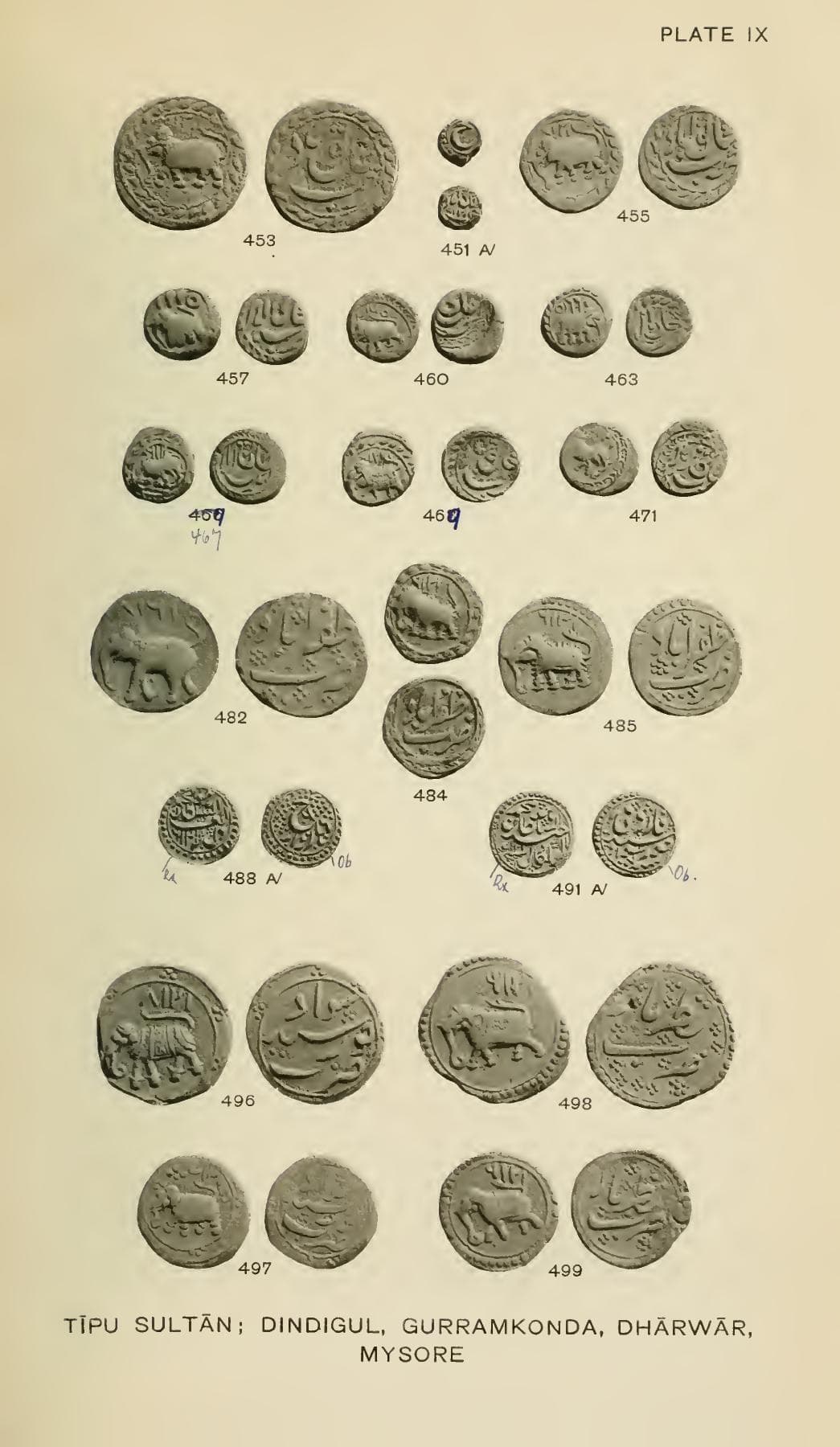
Zafarabad coins in Henderson’s Plate IX ↗ J. R. Henderson · The Coins of Haidar Ali and Tipu Sultan, 1921 · Plate IX · Internet ArchiveSources & Further Reading (3)
University of Manchester Library catalogue · John Rylands Research Institute and Library · Manuscript catalogue · Provenance: Zafarabad administrative seal.
PRIMARY / ARCHIVAL
How this source is used: Provides a separate manuscript-provenance connection with Zafarabad and December 1785. Does not prove permanent renaming of the town.
British Museum, Money and Medals · British Museum · Catalogue date: 1218 · Museum number 1928,0608.40.
NUMISMATIC
How this source is used: Catalogue describes alloy and a weight of 11.425 g. Its date is preserved as catalogued, without treating it as a Common Era date. No image redistribution permission is assumed.
N. Ramesan · Government of Andhra Pradesh; digitised by IGNCA / ASI Library · 1979 · Historical chapter, printed pp. 42–43.
GAZETTEER
How this source is used: A retrospective district account. Its relationship statement is used carefully; construction dates and genealogy need independent confirmation.
Thomas Fraser · British Library · c. 1802 · WD506.
PRIMARY / ARCHIVAL
How this source is used: Watercolour with a key. The catalogue identifies the lower fort and works covering the ascent. The original digital viewer was unavailable during research.
These additional anchors follow photographic and conservation records. ASI dates are reporting periods; the 2015 entry records a reported discovery with an unresolved interpretation.
Archaeological Survey of India · ASI / National Mission on Monuments and Antiquities · Reporting period 1964–65 · Preservation of monuments, Andhra Pradesh, entry 98: Fort, Gurramkonda.
ARCHAEOLOGICAL · Evidence tier A
How this source is used: Reports waterproofing over the inscription slab in the mahal and preservative treatment of second-floor palace woodwork. Does not identify the palace builder.
Archaeological Survey of India · Archaeological Survey of India, Government of India · 1980 (reporting period 1977-78) · Preservation of monuments, entry 256: Fort and Mahal, Gurramkonda, District Chittoor, p. 129. Edited by B. K. Thapar.
ARCHAEOLOGICAL · Evidence tier A
How this source is used: Records restoration of damaged chhajjas around the Mahal in the old style. Entry and printed pagination verified directly against the ASI PDF page image on 12 September 2026 (PDF viewer page 136). This conservation entry does not establish original patronage or construction date.
Archaeological Survey of India · Archaeological Survey of India, Government of India · 1994 (reporting period 1989-90) · Preservation of monuments, entry 174: Rangini Mahal, Gurramkonda, District Chittoor, p. 173. Edited by S. K. Mahapatra.
ARCHAEOLOGICAL · Evidence tier A
How this source is used: Records underpinning cavities in stone platforms and replacement of missing and old chhajja stones with new ones. Entry and printed pagination verified directly against the ASI PDF page image on 12 September 2026 (PDF viewer page 180). This conservation entry does not establish original patronage or construction date.
Archaeological Survey of India · Archaeological Survey of India, Government of India · 1995 (reporting period 1990-91) · Preservation of monuments, entry 164: Rangin Mahal, Gurramkonda, District Chittoor, p. 134. Edited by S. K. Mahapatra.
ARCHAEOLOGICAL · Evidence tier A
How this source is used: Records removal of decayed lime plaster and broken flat tiles over roofs and chhajjas for a fresh weatherproof course. It does not state that the new course was completed. Entry and printed pagination verified directly against the ASI PDF page image on 12 September 2026 (PDF viewer page 142). This conservation entry does not establish original patronage or construction date.
Archaeological Survey of India · Archaeological Survey of India, Government of India · 1997 (reporting period 1992-93) · Preservation of monuments, entry 168: Gurramkonda Fort, Gurramkonda, District Chittoor, p. 165. Edited by Ajai Shankar.
ARCHAEOLOGICAL · Evidence tier A
How this source is used: Records completed combination-mortar plastering of Rangin Mahal’s front and rear sloping chhajjas and relaying brick-jelly concrete over the roof after removing dead lime concrete to address rainwater penetration. Entry and printed pagination verified directly against the ASI PDF page image on 12 September 2026 (PDF viewer page 171). This conservation entry does not establish original patronage or construction date.
Archaeological Survey of India · Archaeological Survey of India, Government of India · 2003 (reporting period 1997-98) · Preservation of monuments, entry 253: Structures inside Gurramkonda Fort, Gurramkonda, District Chittoor, p. 302.
ARCHAEOLOGICAL · Evidence tier A
How this source is used: Records replacement of damaged Rangin Mahal step members with newly dressed slabs; repair or replacement of ground-floor doors, windows and other woodwork; and work to wall plaster in certain areas and damaged flooring. The entry continues across both columns of the same printed page. Entry and printed pagination verified directly against the ASI PDF page image on 12 September 2026 (PDF viewer page 310). This conservation entry does not establish original patronage or construction date.
Syed Akbar · The Times of India · 3 December 2015 · Report of the exposure near the old Idgah and preliminary interpretations.
REPORTING · Evidence tier C
How this source is used: Used for the reported discovery and unresolved alternatives only. Its broad fort-age/builder statements are not adopted. Not an excavation report.