Dated record index
The original chronology records remain here for reference and existing links. Open a record for its summary, evidence and connections; follow its chapter to read the fuller account.
1336 onwards — The Vijayanagara world
DOCUMENTEDVijayanagara was founded in 1336 by Harihara and Bukka. Its political world would shape the southern Deccan, including Rayalaseema.
This regional beginning is not a construction date for Gurramkonda Fort. The isolated rock and the narrow approaches visible in later surveys help explain the hill’s defensive importance.
Read the connected chapter →Sources & Further Reading (2)
- Vijayanagara district: history
District Administration · Government of Karnataka · Undated web record · District introduction.
GOVERNMENT
How this source is used: Regional context for the foundation of Vijayanagara, not a dated foundation record for Gurramkonda Fort.
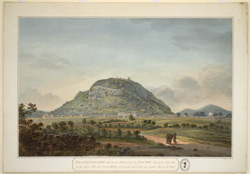
Open external source ↗ - View of the north face of the fort, Gurramkonda
Thomas Fraser · British Library · c. 1802 · WD506.
PRIMARY / ARCHIVAL
How this source is used: Watercolour with a key. The catalogue identifies the lower fort and works covering the ascent. The original digital viewer was unavailable during research.
Open external source ↗
Connected archive records (3)
These links follow associations recorded in the archive. They do not establish a builder, genealogy or precise location.
14th century attribution — A hill before a building date
SUPPORTEDGurramkonda Fort is commonly associated with the Vijayanagara period, but an exact builder and construction year are not established here.
A fort can contain work from several periods. Dating one gateway, wall or palace would not automatically date the entire defensive complex. The early-period attribution remains a research question requiring archaeological or inscriptional evidence.
The monument register confirms surviving remains; it does not establish a 14th-century foundation.
Read the connected chapter →Sources & Further Reading (1)
- List of Centrally Protected Monuments
National Monuments Authority · Ministry of Culture, Government of India · Undated register · Gurramkonda entries in the Andhra Pradesh list.
ARCHAEOLOGICAL
How this source is used: Documents protected remains, including lower fort, wall, moat, gateway, temple, tomb, mandapam and mosque. Older district names reflect the register, not current administrative boundaries.
Open external source ↗
Connected archive records (1)
These links follow associations recorded in the archive. They do not establish a builder, genealogy or precise location.
Related official channel stories (1)
Who Built Gurramkonda Fort? | Complete History of Gurramkonda Fort | Telugu Documentary ↗
The channel explores the fort’s origins. Our archive does not establish an exact builder or construction year; the linked record retains that uncertainty.
1565 onwards — After Talikota
DOCUMENTEDTalikota was a major rupture in Vijayanagara history, but the empire did not immediately disappear in 1565.
The later reign of Venkata II and accounts of his commanders at Gurramkonda show the continuation of Vijayanagara political authority. Frontier forts became places where regional commanders and Deccan powers competed.
Read the connected chapter →Sources & Further Reading (1)
- Further Sources of Vijayanagara History
K. A. Nilakanta Sastri and N. Venkataramanayya · University of Madras; digital transcription at Wisdom Library · 1946 · Volume I, history of Venkata II, printed pp. 316–317.
ACADEMIC
How this source is used: Uses literary and local historical materials. Online OCR is not fully proofread; exact siege year remains unestablished.
Open external source ↗
Connected archive records (2)
These links follow associations recorded in the archive. They do not establish a builder, genealogy or precise location.
Late 16th century — The siege of Gurramkonda
DOCUMENTEDAccounts of Venkata II’s reign connect Matla Anantaraju and Kasturi Rangappa with campaigns against Ravella chiefs and forces associated with Golconda.
The historical synthesis describes Matla Ananta besieging Gurramkonda. Artillery, ammunition and the hill’s strong defences prolonged resistance; damage to a bastion preceded surrender and recovery by Vijayanagara forces.
These accounts preserve an important military episode, but they do not justify assigning a precise year in this archive. Literary praise and later historical reconstruction should be read with attention to their source traditions.
Late 16th century is an approximate placement; no exact siege year is asserted.
Read the connected chapter →Sources & Further Reading (1)
- Further Sources of Vijayanagara History
K. A. Nilakanta Sastri and N. Venkataramanayya · University of Madras; digital transcription at Wisdom Library · 1946 · Volume I, history of Venkata II, printed pp. 316–317.
ACADEMIC
How this source is used: Uses literary and local historical materials. Online OCR is not fully proofread; exact siege year remains unestablished.
Open external source ↗
Connected archive records (5)
These links follow associations recorded in the archive. They do not establish a builder, genealogy or precise location.
17th century — A changing Deccan frontier
RESEARCH LEADThe seventeenth-century succession of authorities at Gurramkonda remains incompletely documented in this collection.
Declining Vijayanagara power and expanding Deccan states provide a regional setting. They do not supply a complete ruler list for this particular fort. Further work must compare local records, inscriptions and dated documents before filling the gaps.
A deliberate gap in the chronology, not evidence of continuous rule by one power.
Read the connected chapter →Sources & Further Reading (1)
- Further Sources of Vijayanagara History
K. A. Nilakanta Sastri and N. Venkataramanayya · University of Madras; digital transcription at Wisdom Library · 1946 · Volume I, history of Venkata II, printed pp. 316–317.
ACADEMIC
How this source is used: Uses literary and local historical materials. Online OCR is not fully proofread; exact siege year remains unestablished.
Open external source ↗
Connected archive records (1)
These links follow associations recorded in the archive. They do not establish a builder, genealogy or precise location.
c. 1714 — Abdul Nabi Khan and the Cuddapah Nawabs
DOCUMENTEDAbdul Nabi Khan’s governorship is associated with the early eighteenth-century consolidation of Cuddapah authority.
Brackenbury’s district gazetteer dates the beginning of his governorship to 1714 and describes Gandikota and Gurramkonda as northern and southern garrison centres. This is a political layer over an older landscape, not proof that the fort was first built in 1714.
The precise appointment date and sequence require comparison with contemporary records.
Read the connected chapter →Sources & Further Reading (1)
- Madras District Gazetteers: Cuddapah
C. F. Brackenbury · Government Press, Madras · 1915 · Printed pp. 41–45: Nawabs, Maratha campaigns and Mysore.
GAZETTEER
How this source is used: A colonial retrospective gazetteer. Political chronology is paraphrased without adopting its prejudicial descriptions of communities or rulers.
Open external source ↗
Connected archive records (2)
These links follow associations recorded in the archive. They do not establish a builder, genealogy or precise location.
1740 — The Maratha intervention
DOCUMENTEDMaratha campaigns reshaped the political balance across the Cuddapah region.
District histories place a major intervention in 1740, affecting the Nawabs of Kurnool and Cuddapah. A regional campaign should not be read as proof that every fort changed hands on the same day.
Regional chronology; a separate Gurramkonda capture date is not established.
Read the connected chapter →Sources & Further Reading (1)
- Madras District Gazetteers: Cuddapah
C. F. Brackenbury · Government Press, Madras · 1915 · Printed pp. 41–45: Nawabs, Maratha campaigns and Mysore.
GAZETTEER
How this source is used: A colonial retrospective gazetteer. Political chronology is paraphrased without adopting its prejudicial descriptions of communities or rulers.
Open external source ↗
Connected archive records (1)
These links follow associations recorded in the archive. They do not establish a builder, genealogy or precise location.
1757 — Gurramkonda under the Marathas
DOCUMENTEDGurramkonda passed into Maratha possession in the settlement following the 1757 campaign.
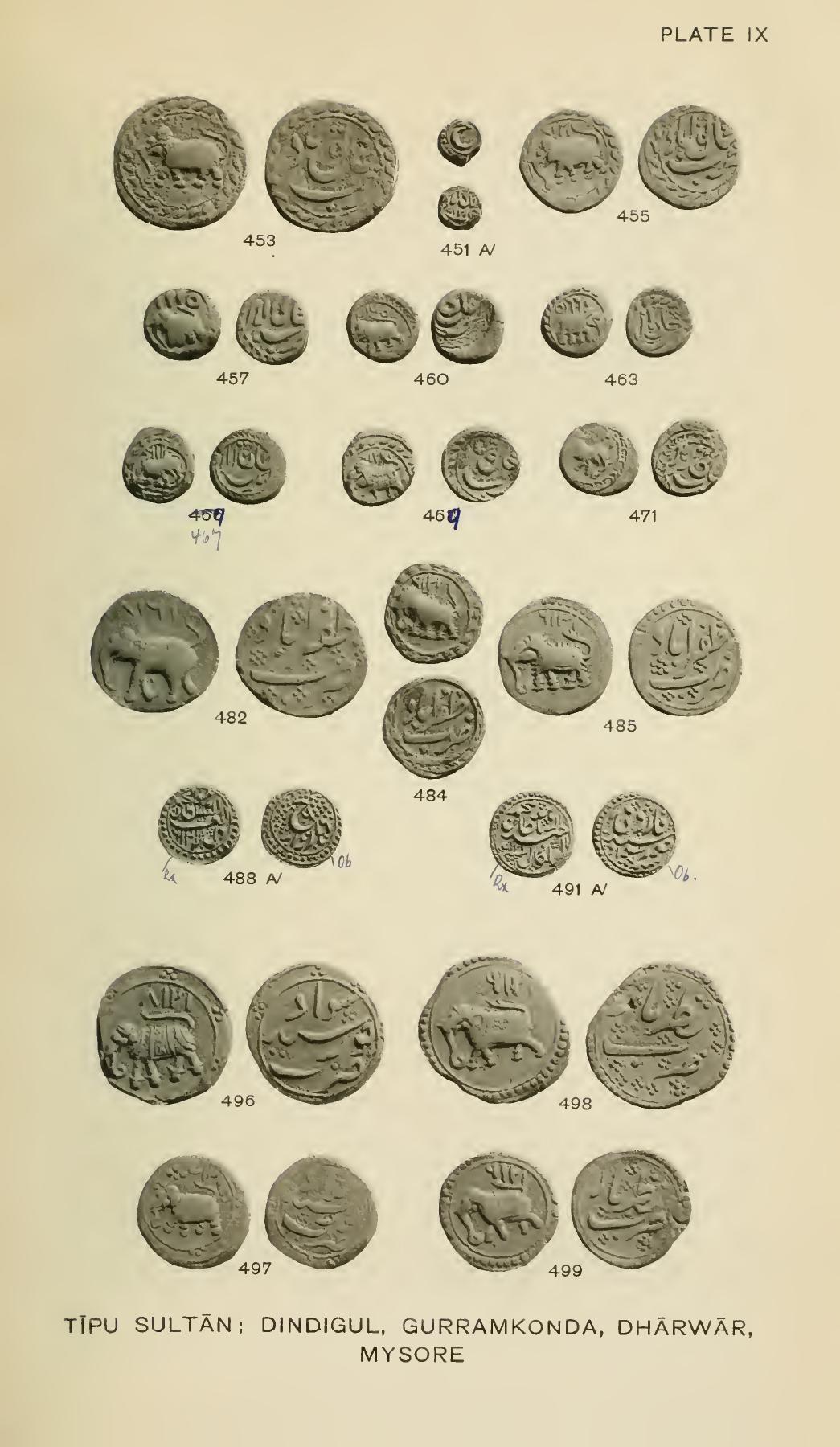
Coins and the Gurramkonda mint: Bhandare identifies undated fanams, but rejects some older horse-rider coin attributions. A coin needs a defensible mint reading; its imagery alone cannot identify Gurramkonda.
Read the connected chapter →Sources & Further Reading (1)
- 18th Century Coinage of the Cuddapah Region
Shailendra Bhandare · Oriental Numismatic Society · 2006 · ONS Newsletter 186; Cuddapah and Gurramkonda discussion.
NUMISMATIC
How this source is used: Research based on coin specimens. Some older Gurramkonda attributions are explicitly rejected; undated coins do not establish a precise year.
Open external source ↗
Connected archive records (2)
These links follow associations recorded in the archive. They do not establish a builder, genealogy or precise location.
1760s — Hyder Ali, the Marathas and Mir Ali Raza Khan
DOCUMENTEDGurramkonda changed hands amid Mysore–Maratha struggles. The Chittoor gazetteer identifies Mir Ali Raza Khan as Hyder Ali’s brother-in-law.
He became closely associated with the fort during these negotiations and conflicts. Sheikh Ali identifies his sister Fakhr-un-Nissa as Tipu Sultan’s mother, establishing the maternal-uncle relationship. This genealogy does not establish her birthplace or residence at Gurramkonda.
Accounts differ over individual transfers in the 1760s. The supported family relationship does not resolve that chronology.
Read the connected chapter →Sources & Further Reading (2)
- Andhra Pradesh District Gazetteers: Chittoor
N. Ramesan · Government of Andhra Pradesh; digitised by IGNCA / ASI Library · 1979 · Historical chapter, printed pp. 42–43.
GAZETTEER
How this source is used: A retrospective district account. Its relationship statement is used carefully; construction dates and genealogy need independent confirmation.
Open external source ↗ - Tipu Sultan: A Crusader for Change — Early Life and Accession to Power
B. Sheikh Ali · Author’s digital text, reproduced in a public FlipHTML5 reader · Digital edition; publication year not established in the inspected copy · Chapter 1, opening page (text-version p. 1; reader page 15 of 448).
ACADEMIC / SECONDARY · Evidence tier B
How this source is used: The actual reader page was inspected, not just its search snippet. It identifies Fatima, also called Fakhr-un-Nissa, as Tipu’s mother, daughter of Mir Moin-ud-din, Governor of Cuddapah, and sister of Mir Ali Raza Khan. The uploader’s 2006 label is not treated as verified edition metadata or conflated with the separately catalogued 2012 edition. Its Porto Novo / July 1781 death statement conflicts with the Chittoor gazetteer’s 1782 account; accepting the genealogy does not resolve that conflict. No birthplace or residence at Gurramkonda is established.
Open external source ↗
Connected archive records (4)
These links follow associations recorded in the archive. They do not establish a builder, genealogy or precise location.
1768 — Hyder Ali and the First Anglo-Mysore War
SUPPORTEDDuring the First Anglo-Mysore War, Gurramkonda served as a point where Hyder Ali obtained reinforcements, according to Bowring’s campaign account.
Bowring describes Hyder returning to Gurramkonda, where Ali Raza Khan joined him with trained troops. Reinforced, Hyder moved back toward Kolar. This account establishes a military role for the town; it does not establish a permanent headquarters or an exact troop strength.
The reinforcement episode is described on printed page 53. Its placement in the 1768 campaign requires comparison with dated military correspondence.
Read the connected chapter →Sources & Further Reading (1)
- Haidar Ali and Tipu Sultan and the Struggle with the Musalman Powers of the South
Lewin B. Bowring · Clarendon Press, Oxford · 1893 · Chapter VIII, printed pp. 52–54; Gurramkonda reinforcements on p. 53.
SECONDARY
How this source is used: A retrospective colonial military history. Used for the described movement and reinforcement episode; exact campaign dating requires comparison with contemporary dispatches.
Open external source ↗
Connected archive records (2)
These links follow associations recorded in the archive. They do not establish a builder, genealogy or precise location.
1772 — Ceded to the Marathas
DOCUMENTEDGurramkonda returned to Maratha possession in 1772.
This transfer belongs to the alternating control of the fort during Hyder Ali’s conflicts with the Marathas. Henderson’s mint history places Mysore’s recovery early in 1774.
Read the connected chapter →Sources & Further Reading (2)
- 18th Century Coinage of the Cuddapah Region
Shailendra Bhandare · Oriental Numismatic Society · 2006 · ONS Newsletter 186; Cuddapah and Gurramkonda discussion.
NUMISMATIC
How this source is used: Research based on coin specimens. Some older Gurramkonda attributions are explicitly rejected; undated coins do not establish a precise year.
Open external source ↗ - The Coins of Haidar Ali and Tipu Sultan
J. R. Henderson · Government Press, Madras · 1921 · Mint discussion: Zafarabad (Gurramkonda).
NUMISMATIC
How this source is used: Historical museum catalogue; compare its identifications with later numismatic scholarship.
Open external source ↗
Connected archive records (2)
These links follow associations recorded in the archive. They do not establish a builder, genealogy or precise location.
1774 · date disputed — Tipu captures Gurramkonda
SUPPORTEDHenderson and the Chittoor gazetteer date Tipu’s capture of Gurramkonda to 1774, during Hyder Ali’s rule.
The gazetteer describes Hyder sending his son against the fort. Its recovery re-established Mysorean control over a strategically important position.
A later ONS study instead gives 1778. The capture is supported, but the disagreement in year remains visible until contemporary campaign records resolve it.
1774 is the chronology followed here; ONS 186 gives 1778.
Read the connected chapter →Sources & Further Reading (3)
- The Coins of Haidar Ali and Tipu Sultan
J. R. Henderson · Government Press, Madras · 1921 · Mint discussion: Zafarabad (Gurramkonda).
NUMISMATIC
How this source is used: Historical museum catalogue; compare its identifications with later numismatic scholarship.
Open external source ↗ - Andhra Pradesh District Gazetteers: Chittoor
N. Ramesan · Government of Andhra Pradesh; digitised by IGNCA / ASI Library · 1979 · Historical chapter, printed pp. 42–43.
GAZETTEER
How this source is used: A retrospective district account. Its relationship statement is used carefully; construction dates and genealogy need independent confirmation.
Open external source ↗ - 18th Century Coinage of the Cuddapah Region
Shailendra Bhandare · Oriental Numismatic Society · 2006 · ONS Newsletter 186; Cuddapah and Gurramkonda discussion.
NUMISMATIC
How this source is used: Research based on coin specimens. Some older Gurramkonda attributions are explicitly rejected; undated coins do not establish a precise year.
Open external source ↗
Connected archive records (4)
These links follow associations recorded in the archive. They do not establish a builder, genealogy or precise location.
c. 1781–1782 — Remembering Mir Ali Raza Khan
CONFLICTING EVIDENCEMir Ali Raza Khan is associated with a burial monument at Gurramkonda. The Chittoor gazetteer places his death in 1782.
Sheikh Ali instead places his death at Porto Novo in July 1781. The conflicting accounts remain visible pending comparison of death and inscription records; neither a definitive place nor war of death is assigned here. A contributed photograph of a domed monument has not been independently matched to his maqbara.
1782 and July 1781 are conflicting published accounts. The separate Cuddalore retelling remains unverified.
Read the connected chapter →Sources & Further Reading (2)
- Andhra Pradesh District Gazetteers: Chittoor
N. Ramesan · Government of Andhra Pradesh; digitised by IGNCA / ASI Library · 1979 · Historical chapter, printed pp. 42–43.
GAZETTEER
How this source is used: A retrospective district account. Its relationship statement is used carefully; construction dates and genealogy need independent confirmation.
Open external source ↗ - Tipu Sultan: A Crusader for Change — Early Life and Accession to Power
B. Sheikh Ali · Author’s digital text, reproduced in a public FlipHTML5 reader · Digital edition; publication year not established in the inspected copy · Chapter 1, opening page (text-version p. 1; reader page 15 of 448).
ACADEMIC / SECONDARY · Evidence tier B
How this source is used: The actual reader page was inspected, not just its search snippet. It identifies Fatima, also called Fakhr-un-Nissa, as Tipu’s mother, daughter of Mir Moin-ud-din, Governor of Cuddapah, and sister of Mir Ali Raza Khan. The uploader’s 2006 label is not treated as verified edition metadata or conflated with the separately catalogued 2012 edition. Its Porto Novo / July 1781 death statement conflicts with the Chittoor gazetteer’s 1782 account; accepting the genealogy does not resolve that conflict. No birthplace or residence at Gurramkonda is established.
Open external source ↗
Connected archive records (2)
These links follow associations recorded in the archive. They do not establish a builder, genealogy or precise location.
1783 — Mir Qamruddin
DOCUMENTEDBhandare identifies Mir Qamruddin as Mir Raza Ali’s son and Tipu’s officer at Gurramkonda and Cuddapah.
The study records his defeat of troops supporting Sayyid Ahmed’s rival claim in 1783.
Read the connected chapter →Sources & Further Reading (1)
- 18th Century Coinage of the Cuddapah Region
Shailendra Bhandare · Oriental Numismatic Society · 2006 · ONS Newsletter 186; Cuddapah and Gurramkonda discussion.
NUMISMATIC
How this source is used: Research based on coin specimens. Some older Gurramkonda attributions are explicitly rejected; undated coins do not establish a precise year.
Open external source ↗
Connected archive records (3)
These links follow associations recorded in the archive. They do not establish a builder, genealogy or precise location.
December 1785 — Gurramkonda & Zafarabad
DOCUMENTEDGurramkonda became associated with Tipu Sultan’s mint-name Zafarabad, approximately “City of Victory.”
Henderson’s catalogue places the transfer of the Zafarabad mint-name from Mercara to Gurramkonda in December 1785. It lists a small series of paisas and half-paisas.
The University of Manchester’s Persian manuscript catalogue also records a Zafarabad administrative seal. These are valuable traces of administration and coinage; they do not establish that the whole town was permanently renamed.
Read the connected chapter →Sources & Further Reading (3)
- The Coins of Haidar Ali and Tipu Sultan
J. R. Henderson · Government Press, Madras · 1921 · Mint discussion: Zafarabad (Gurramkonda).
NUMISMATIC
How this source is used: Historical museum catalogue; compare its identifications with later numismatic scholarship.
Open external source ↗ - Mirʾāt-i Sikandarī: Persian MS 900
University of Manchester Library catalogue · John Rylands Research Institute and Library · Manuscript catalogue · Provenance: Zafarabad administrative seal.
PRIMARY / ARCHIVAL
How this source is used: Provides a separate manuscript-provenance connection with Zafarabad and December 1785. Does not prove permanent renaming of the town.
Open external source ↗ - Coin of Sultan Tipu, Zafarabad mint
British Museum, Money and Medals · British Museum · Catalogue date: 1218 · Museum number 1928,0608.40.
NUMISMATIC
How this source is used: Catalogue describes alloy and a weight of 11.425 g. Its date is preserved as catalogued, without treating it as a Common Era date. No image redistribution permission is assumed.
Open external source ↗
Connected archive records (5)
These links follow associations recorded in the archive. They do not establish a builder, genealogy or precise location.
Related official channel stories (1)
మీకు తెలుసా? గుర్రంకొండలో ఒకప్పుడు నాణేల ముద్రణ కేంద్రం ఉండేది! | Historical Facts ↗
A short channel presentation about coinage. Read the archive’s qualified Zafarabad account alongside the video.
1790–1792 — The Third Anglo-Mysore War
DOCUMENTEDThe East India Company, the Nizam of Hyderabad and the Marathas opposed Tipu Sultan.
Gurramkonda’s fortifications again mattered in the struggle for territory. Military occupation, a successful assault and a treaty transfer are distinct events; the chronology separates them.
Read the connected chapter →Sources & Further Reading (2)
- Imperial Gazetteer of India: Cuddapah
W. W. Hunter, editor · Imperial Gazetteer of India · 19th century edition · Volume IV, Cuddapah entry.
GAZETTEER
How this source is used: Colonial administrative account. Its political summaries need to be read critically alongside regional scholarship.
Open external source ↗ - The Coins of Haidar Ali and Tipu Sultan
J. R. Henderson · Government Press, Madras · 1921 · Mint discussion: Zafarabad (Gurramkonda).
NUMISMATIC
How this source is used: Historical museum catalogue; compare its identifications with later numismatic scholarship.
Open external source ↗
Connected archive records (2)
These links follow associations recorded in the archive. They do not establish a builder, genealogy or precise location.
1791 — The siege of Goorumconda
DOCUMENTEDGoorumconda is a spelling used in British accounts of Gurramkonda. Fighting around its defences formed part of the Third Anglo-Mysore War.
The Chittoor gazetteer describes the Nizam’s forces beginning a siege in September. Guns supplied through Captain Read helped breach the lower defences, while the garrison withdrew to the upper fort. A Mysorean relief force led by Tipu’s son Futteh Hyder then intervened. Renewed allied operations recovered the lower works, but the upper fort held out until the 1792 settlement. Precise November and December dates remain under review.
The political outcome must be read with the 1792 settlement. A claim that Britain permanently acquired the town in 1791 conflates siege operations with territorial transfer.
Detailed day-by-day military chronology remains under review.
Read the connected chapter →Sources & Further Reading (2)
- Andhra Pradesh District Gazetteers: Chittoor
N. Ramesan · Government of Andhra Pradesh; digitised by IGNCA / ASI Library · 1979 · Historical chapter, printed pp. 42–43.
GAZETTEER
How this source is used: A retrospective district account. Its relationship statement is used carefully; construction dates and genealogy need independent confirmation.
Open external source ↗ - The Coins of Haidar Ali and Tipu Sultan
J. R. Henderson · Government Press, Madras · 1921 · Mint discussion: Zafarabad (Gurramkonda).
NUMISMATIC
How this source is used: Historical museum catalogue; compare its identifications with later numismatic scholarship.
Open external source ↗
Connected archive records (4)
These links follow associations recorded in the archive. They do not establish a builder, genealogy or precise location.
1792 — Treaty of Seringapatam
DOCUMENTEDAfter the 1792 settlement, Gurramkonda and the Cuddapah territory passed to the Nizam of Hyderabad.
Tipu lost extensive territory. Henderson records Gurramkonda among the places he relinquished. The Nizam’s acquisition is distinct from the later East India Company administration beginning with the cession of 1800.
Read the connected chapter →Sources & Further Reading (2)
- Imperial Gazetteer of India: Cuddapah
W. W. Hunter, editor · Imperial Gazetteer of India · 19th century edition · Volume IV, Cuddapah entry.
GAZETTEER
How this source is used: Colonial administrative account. Its political summaries need to be read critically alongside regional scholarship.
Open external source ↗ - The Coins of Haidar Ali and Tipu Sultan
J. R. Henderson · Government Press, Madras · 1921 · Mint discussion: Zafarabad (Gurramkonda).
NUMISMATIC
How this source is used: Historical museum catalogue; compare its identifications with later numismatic scholarship.
Open external source ↗
Connected archive records (2)
These links follow associations recorded in the archive. They do not establish a builder, genealogy or precise location.
1795 — The Raymond connection
SUPPORTEDThe Imperial Gazetteer links Cuddapah revenues with M. Raymond’s French military contingent in the Nizam’s service.
Michel Joachim Marie Raymond’s connection belongs to the wider military and financial politics of Hyderabad. The precise boundaries, tenure and local administration of any Gurramkonda grant still need documentary confirmation.
Regional jagir connection; do not imply a separately verified personal visit or building commission at Gurramkonda.
Read the connected chapter →Sources & Further Reading (1)
- Imperial Gazetteer of India: Cuddapah
W. W. Hunter, editor · Imperial Gazetteer of India · 19th century edition · Volume IV, Cuddapah entry.
GAZETTEER
How this source is used: Colonial administrative account. Its political summaries need to be read critically alongside regional scholarship.
Open external source ↗
Connected archive records (2)
These links follow associations recorded in the archive. They do not establish a builder, genealogy or precise location.
4 May 1799 — The fall of Tipu Sultan
DOCUMENTEDTipu Sultan was killed at Srirangapatna on 4 May 1799.
The defeat changed the political settlement of southern India. Gurramkonda’s own transition into sustained Company administration is dated here to the Nizam’s cession in 1800.
Read the connected chapter →Sources & Further Reading (2)
- The last effort and fall of Tippo Sultaun, 1799
National Army Museum catalogue · National Army Museum · Catalogue of historical illustration · Collection record 1971-02-33-386-1.
SECONDARY
How this source is used: Used for the date and context of Tipu’s death. The later illustration is not an eyewitness photograph.
Open external source ↗ - Imperial Gazetteer of India: Bellary District
Imperial Gazetteer editors · Government of India · 1908 · Volume VII, Bellary District, historical administration.
GAZETTEER
How this source is used: Records Munro, the 1800 cession and division into Bellary and Cuddapah in 1808.
Open external source ↗
Connected archive records (1)
These links follow associations recorded in the archive. They do not establish a builder, genealogy or precise location.
1800 — From fortress to the Ceded Districts
DOCUMENTEDThe Nizam ceded territories to the East India Company in 1800. The Cuddapah region became part of the Ceded Districts.
Thomas Munro was the first principal collector of the newly acquired territory. Military strongholds now also belonged to a system of revenue assessment and district government.
The transition toward ryotwari revenue arrangements must be understood through village records and administrative correspondence. The archive does not assume that one uniform system began in every village on a single date.
Read the connected chapter →Sources & Further Reading (2)
- Imperial Gazetteer of India: Bellary District
Imperial Gazetteer editors · Government of India · 1908 · Volume VII, Bellary District, historical administration.
GAZETTEER
How this source is used: Records Munro, the 1800 cession and division into Bellary and Cuddapah in 1808.
Open external source ↗ - The Coins of Haidar Ali and Tipu Sultan
J. R. Henderson · Government Press, Madras · 1921 · Mint discussion: Zafarabad (Gurramkonda).
NUMISMATIC
How this source is used: Historical museum catalogue; compare its identifications with later numismatic scholarship.
Open external source ↗
Connected archive records (3)
These links follow associations recorded in the archive. They do not establish a builder, genealogy or precise location.
c. 1802 — The British record Gurramkonda
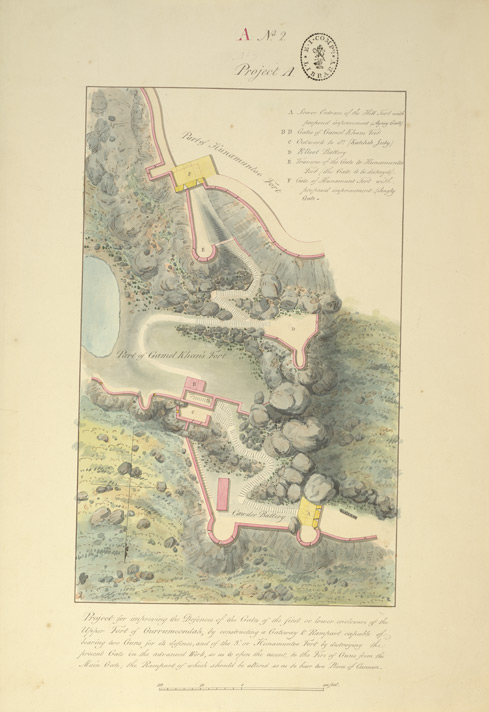
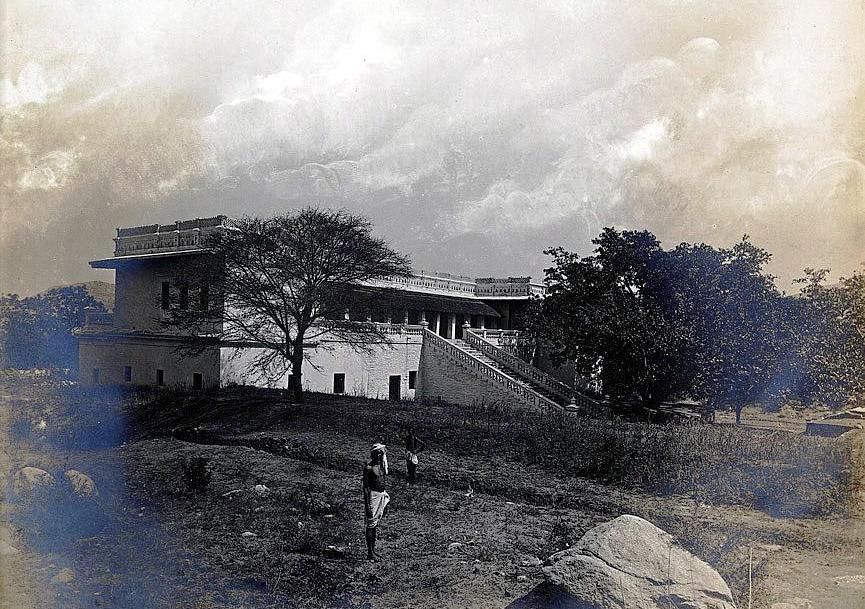
DOCUMENTEDFortress plans, gate proposals, a Ranamandal battery plan and palace drawings preserve an extraordinary architectural record.
The British Library credits the fortress plan to John Gantz and several other drawings to Thomas Fraser. The north-face view records lower defences and works along the approach to the rock.
Read these documents as evidence with a purpose: an improvement plan may depict intended work rather than a completed building. A palace survey establishes the surveyed structure, not its original patron.
Read the connected chapter →Sources & Further Reading (3)
- Gurramkonda plans, WD506a–e
John Gantz and Thomas Fraser · British Library · c. 1802 · WD506a fortress; WD506b gates; WD506c Ranamandal battery; WD506d–e palace.
PRIMARY / ARCHIVAL
How this source is used: The catalogue attributes the fortress plan to John Gantz. Improvement plans show proposals, not necessarily completed works.
Open external source ↗ - View of the north face of the fort, Gurramkonda
Thomas Fraser · British Library · c. 1802 · WD506.
PRIMARY / ARCHIVAL
How this source is used: Watercolour with a key. The catalogue identifies the lower fort and works covering the ascent. The original digital viewer was unavailable during research.
Open external source ↗ - Palace second-floor plan and west elevation, Gurramkonda
Thomas Fraser · British Library · c. 1802 · WD506d, A.No.4.
PRIMARY / ARCHIVAL
How this source is used: Evidence of a surveyed palace, not by itself proof of its builder or an exact construction date.
Open external source ↗
Connected archive records (10)
These links follow associations recorded in the archive. They do not establish a builder, genealogy or precise location.
1808 — Cuddapah collectorate
DOCUMENTEDThe Ceded Districts were divided into Bellary and Cuddapah in 1808.
Gurramkonda’s nineteenth-century history must be read through these changing administrative boundaries. Older documents may use Cuddapah or Chittoor rather than the town’s present district name.
Read the connected chapter →Sources & Further Reading (1)
- Imperial Gazetteer of India: Bellary District
Imperial Gazetteer editors · Government of India · 1908 · Volume VII, Bellary District, historical administration.
GAZETTEER
How this source is used: Records Munro, the 1800 cession and division into Bellary and Cuddapah in 1808.
Open external source ↗
Connected archive records (1)
These links follow associations recorded in the archive. They do not establish a builder, genealogy or precise location.
1858 — The end of Company rule
DOCUMENTEDThe Government of India Act 1858 transferred the East India Company’s governing powers to the Crown.
This closes the main chronology’s Company period. It does not end Gurramkonda’s history: architecture, religious life, family memories and the town’s everyday landscape continue into the living archive.
Read the connected chapter →Sources & Further Reading (1)
- East India Company and Raj, 1785–1858
UK Parliament · UK Parliament · Undated historical overview · Government of India Act 1858.
GOVERNMENT
How this source is used: The end of Company government should not be confused with the later dissolution of the Company.
Open external source ↗
Connected archive records (1)
These links follow associations recorded in the archive. They do not establish a builder, genealogy or precise location.